
Articles
Resources – RPA
Reports

KPMG ‘Bots in rev cycle
Hospitals are in a bind. As the shift toward value-based contracts intensifies, revenue cycle operations are becoming increasingly complex. Payers are exploring new ways to quantify value as it relates to reimbursement, which puts additional pressure on hospitals to provide documentation to support claims. Even positive developments such as lower unemployment have led to higher labor costs. All of this has the potential to decrease hospitals’ cash flow and negatively impact the bottom line. Hospitals increase revenue recovery with robotic process automation AI is defined as the combination of cognitive automation, machine learning, reasoning, hypothesis generation and analysis, natural language processing, and intentional algorithm mutation to produce insights and analytics at or above human capability.

Robotic Process Automation in the Healthcare Industry
COVID-19 has had a massive impact on healthcare providers. Dire need has pushed many healthcare professionals to the limit to the point of affecting their own health.
According to Gartner, 50% of US healthcare providers will invest in RPA over the next three years. Artificial Intelligence (AI) enablement within clinical or nonclinical processes for patient interactions, which is a mere 4% today, will increase at least five fold.
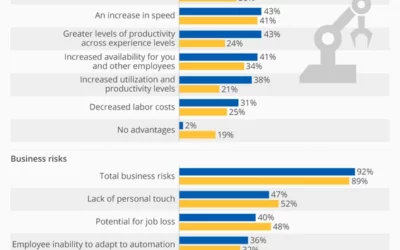
Overview of Robotic Process Automation in the Healthcare Industry
According to a report published by the United States Census Bureau in 2016, a new demographic trend has emerged. By 2020, people over the age of 65 will outnumber children under 5. And by 2050, the percentage of people 65 and over will be more than twice the percentage of young children. This so-called “demographic earthquake” is expected to start taking effect on the global labour market.
This means, among others, that the number of people who need medical assistance is also on the rise. The healthcare industry must find the resources to adapt to this new demographic trend. Robotic process automation in healthcare should thus be taken full advantage of, in the attempt to provide adequate medical care to a larger number of people.

RPA in the Healthcare Industry
Robotic Process Automation (RPA) might not be one of the first options discussed when considering the implementation of process automation in the healthcare industry, but it is a place where RPA has the potential for great transformation.
RPA is essential to streamlining back-office processes in order to eliminate paperwork and reduce the amount of time it takes to process files. However, RPA goes far beyond these simple tasks. It helps healthcare providers not only reduce costs and gain efficiency, but also increase the quality of patient care and the amount of time spent with patients.

Virtual care during Covid-19 delivers impressive benefits for cancer patients
Connection, compassion and considerate patient care proves to be beyond achievable through virtual methods. Patients and healthcare providers at the Princess Margaret Cancer Centre rated virtual care during COVID-19 as highly satisfactory overall for quality of care...